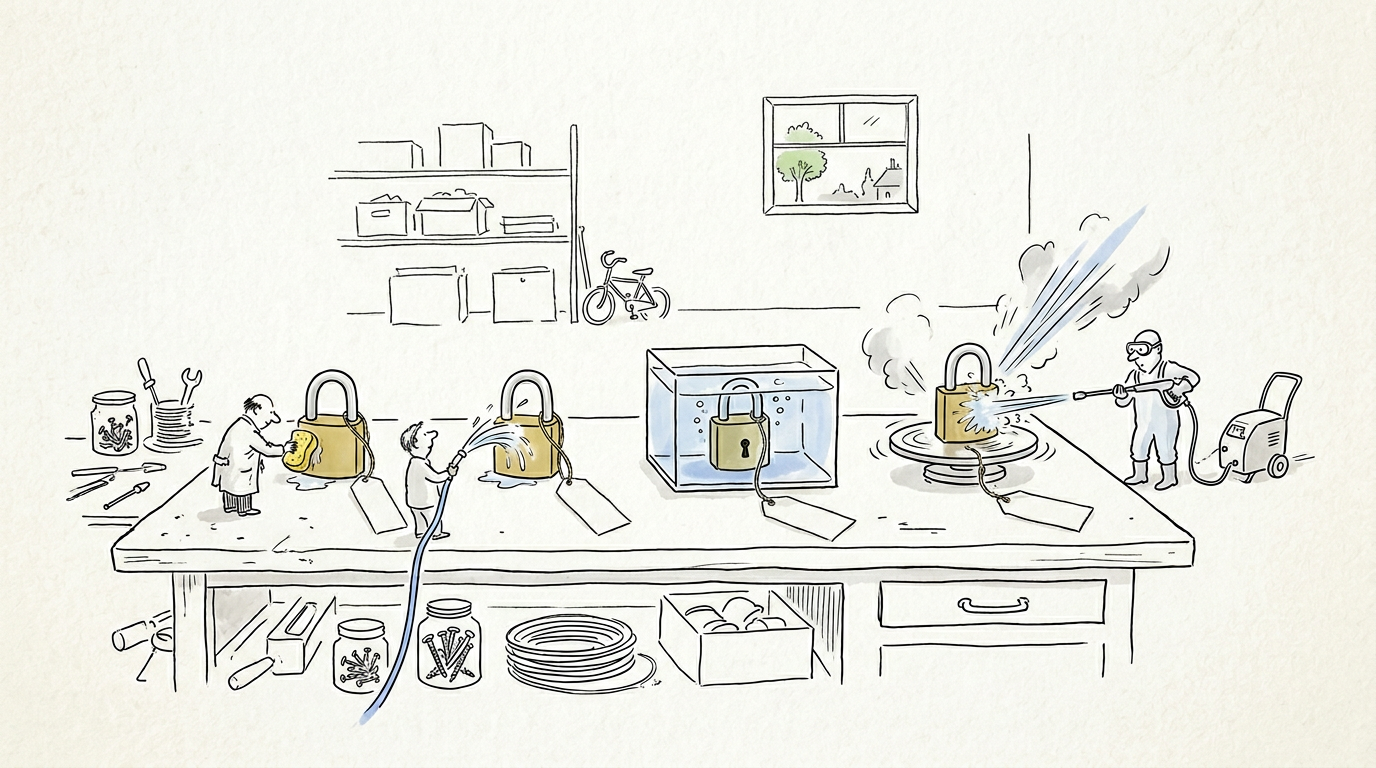
IP ratings use two digits: the first (0-6) covers solid objects, the second (0-9K) covers water. Most online charts stop there. They skip the test conditions that actually matter, ignore the supplementary letters on half your datasheets, and treat IP68 as a fixed standard when the depth is manufacturer-defined.
The first digit: solid object protection
The first digit tells you what size object the enclosure keeps out. Or doesn't. A 0 means no protection at all. A 6 means dust can't get in even under vacuum.
| Digit | Protected against | Test probe / method |
|---|---|---|
| 0 | Nothing | No test |
| 1 | Objects >50mm | 50mm sphere (back of hand) |
| 2 | Objects >12.5mm | 12.5mm probe (finger) |
| 3 | Objects >2.5mm | 2.5mm probe (tool tip) |
| 4 | Objects >1mm | 1mm wire probe |
| 5 | Dust-protected | 80 vol/h vacuum, 8h, limited ingress OK |
| 6 | Dust-tight | 80 vol/h vacuum, 8h, zero ingress |
The jump from 5 to 6 matters more than the numbers suggest. Dust-protected (5) allows some particles in, as long as they don't interfere with operation. Dust-tight (6) means none. Zero. The test runs for 8 hours under a 2 kPa vacuum that actively pulls air through any gap. If dust gets in, it fails.
The second digit: water protection
This is where charts fall apart. They'll tell you IPX5 is "water jets" and IPX6 is "powerful water jets." That's useless. The difference is 12.5 L/min versus 100 L/min. Eight times the flow rate.
| Digit | Description | Test conditions | Typical environment |
|---|---|---|---|
| 0-2 | Light moisture | Drips to spray, indoor conditions | Covered indoor areas |
| 3 | Spraying water | 0.7 L/min per hole, oscillating tube, 5 min | Sheltered outdoor |
| 4 | Splashing | Same, from all directions | Outdoor with roof cover |
| 5 | Water jets | 12.5 L/min, 6.3mm nozzle, 3 min | Exposed outdoor equipment |
| 6 | Powerful jets | 100 L/min, 12.5mm nozzle, 3 min | Deck-mounted, hose-down areas |
| 7 | Immersion 1m | 1m depth, 30 min | Temporary flooding zones |
| 8 | Beyond 1m | Depth/duration per manufacturer | Continuous submersion |
| 9K | High-pressure washdown | 80-100 bar, 80°C, 14-16 L/min, 30 sec/position | Food processing lines |
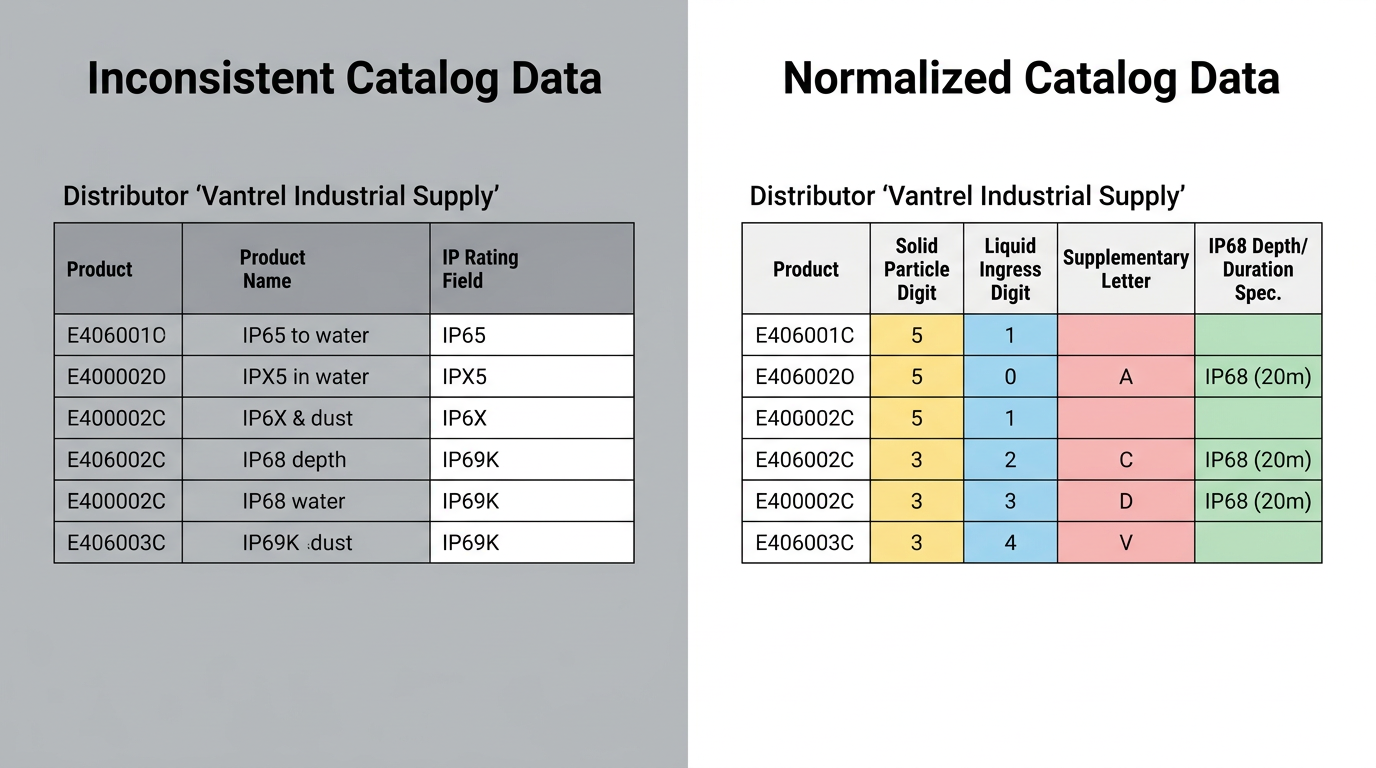
IP69K originated in DIN 40050-9, not IEC 60529. The test is brutal: water at 80°C, pressurized to 80-100 bar, sprayed from 10-15cm away while the product rotates on a turntable at 5 rpm. Thirty seconds per nozzle angle.
But IP69K doesn't include immersion. A product rated IP69K can survive industrial washdown and still flood if you drop it in a tank. That's why some datasheets show IP6K9K, combining dust-tight, submersible, and washdown ratings.
What the X placeholder actually means
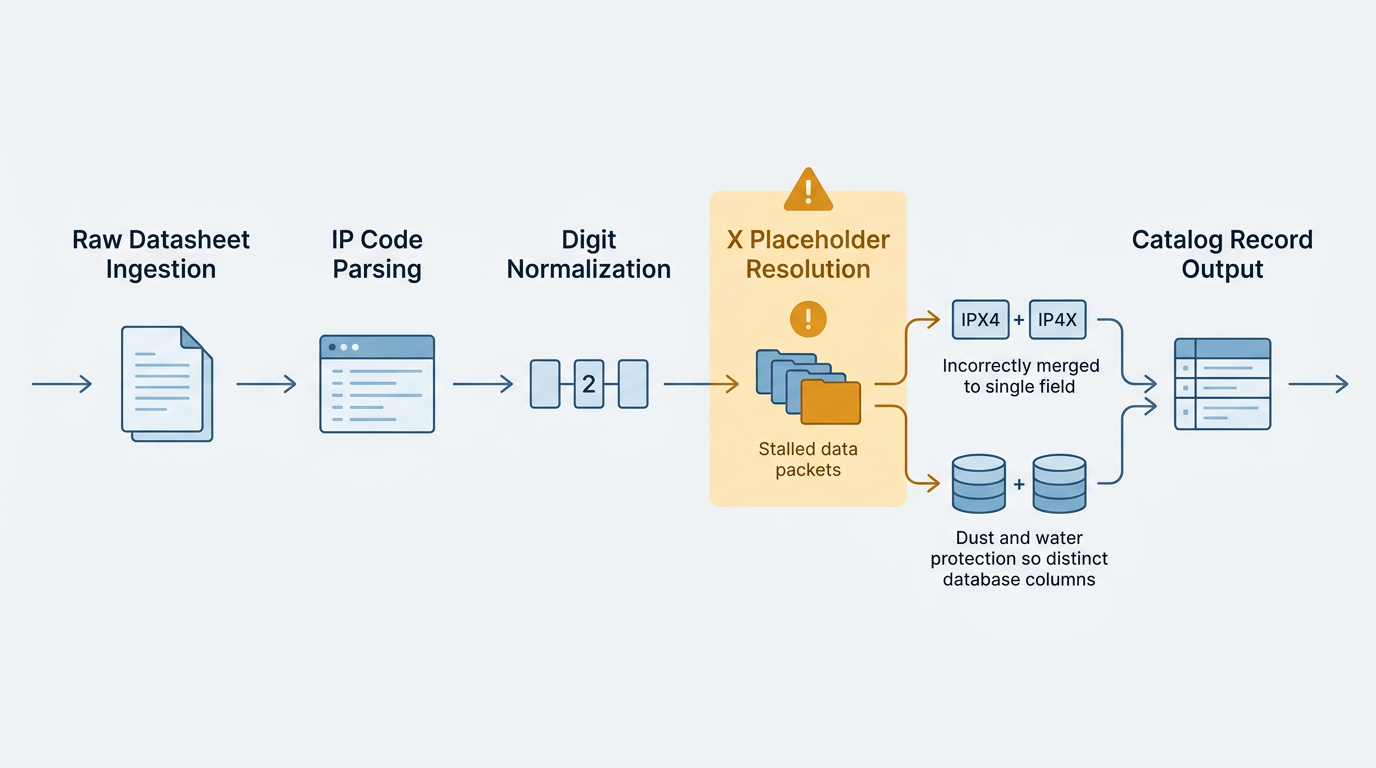
IPX4 doesn't mean "solid protection unknown." It means solids weren't tested. That's a real distinction in catalog data.
Supplier feed values
- IP54
- IPX4
- IP 54
- IP-54
After normalization
- IP54 (tested both)
- IPX4 (water only, solids not assessed)
Your PIM shouldn't merge these. IPX4 and IP54 are different claims. One tested both characteristics, one tested only water. When you're building filter facets, that X needs to stay visible or you'll mislead buyers comparing enclosure ratings. You can check whether a specific code is valid using our IP rating validator.
Supplementary letters most charts skip
Datasheets for motors, high-voltage gear, and outdoor equipment often include letters after the digits.
| Letter | Meaning | When it appears |
|---|---|---|
| A | Back of hand access probe | Hazardous parts protection |
| B | Finger access probe | Consumer electronics |
| C | Tool access probe | Industrial machinery |
| D | Wire access probe | High-voltage apparatus |
| H | High-voltage apparatus | Switchgear, transformers |
| M | Moving during water test | Motors, fans, rotating equipment |
| S | Stationary during water test | Same equipment, different test mode |
| W | Weather conditions | Outdoor installations |
The M and S letters matter for motors. A pump rated IP55M was tested with the shaft spinning. IP55S was tested stationary. Water behaves differently around moving seals. If your application runs continuously, you want the M rating.
Picking the right rating for the environment
Indoor, climate-controlled: IP20-IP44. Finger or splash protection. Outdoor under shelter: IP54-IP55. Dust-protected, jet-resistant. Fully exposed outdoor: IP65-IP66. Dust-tight, powerful jets. Temporary submersion or washdown: IP67 for immersion, IP69K for high-pressure cleaning.
A junction box on an exterior wall needs IP66 at minimum. IP65 handles 12.5 L/min from a hose. IP66 handles 100 L/min. In a real rainstorm with wind-driven water, you want the margin. For a deeper explanation of what each code means in practice, see IP rating explained. If you need to decide between common ratings for a specific install, the IP54 vs IP65 vs IP67 comparison breaks down the trade-offs.
The IP68 trap
Two products can both carry IP68 and differ by 2 meters of depth and 3.5 hours of test duration. The standard says only that depth must exceed 1m, conditions agreed between manufacturer and user.
IEC 60529 deliberately leaves IP68 open. It's not a fixed spec.
| Product | Marked rating | Test depth | Test duration |
|---|---|---|---|
| Voltara JB-68 | IP68 | 1.5m | 30 min |
| Seldec WP-68 | IP68 | 3m | 4 hours |
Same badge. One survives wading pools, the other survives equipment vaults. If you're cataloging submersible connectors or specifying enclosures for wet wells, the IP68 badge tells you nothing without the test report. Check the datasheet fine print. Look for depth and duration. If it's not there, ask the manufacturer before you assume equivalence.