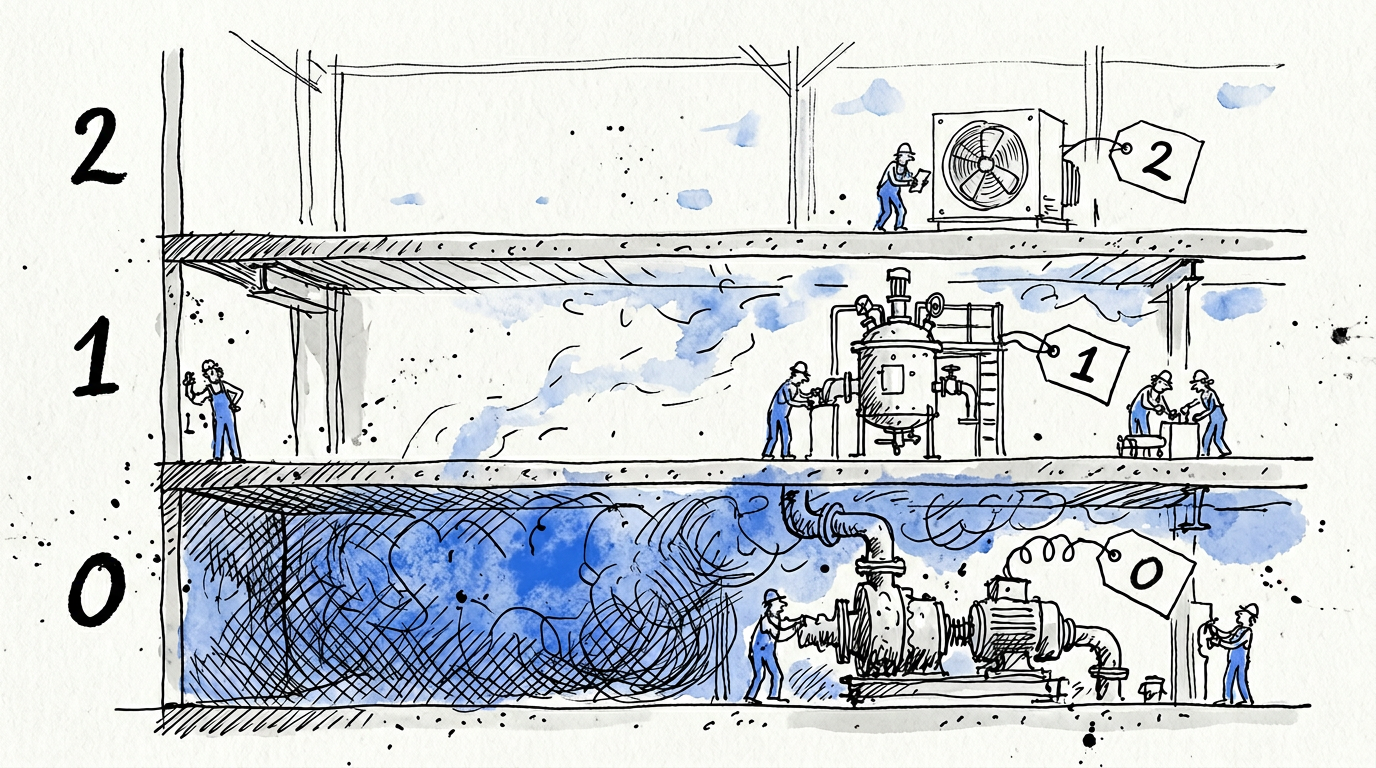
ATEX zones tell you how often an explosive atmosphere shows up. That's it. The zone number drives which equipment category you need. Zone 0/1/2 cover gas. Zone 20/21/22 cover dust. You can always install higher-category equipment in a lower-hazard zone, but never the reverse.
What a zone actually measures
Zones classify frequency, not severity. IEC 60079-10-1 governs gas. IEC 60079-10-2 governs dust.
Zone 0: Explosive gas atmosphere present continuously or for long periods. Think inside sealed tanks.
Zone 1: Explosive atmosphere likely during normal operation, occasionally. Around pump seals, flanges, filling points.
Zone 2: Explosive atmosphere unlikely in normal operation. If it occurs, it's brief. The wider floor area of a pump room.
Dust zones follow the same logic. Zone 20 is continuous dust cloud. Zone 21 is occasional. Zone 22 is rare.
The zone-to-category reference
This is the table you're looking for.
| Zone | Type | Frequency | Equipment Category | EPL | Fault tolerance | Example location |
|---|---|---|---|---|---|---|
| 0 | Gas | Continuous or long periods | 1G | Ga | Must remain safe with two faults | Inside a fuel tank headspace |
| 1 | Gas | Likely in normal operation | 2G | Gb | Must remain safe with one fault | Around a pump seal or flange |
| 2 | Gas | Unlikely, brief if at all | 3G | Gc | Normal operation only | Pump room floor area |
| 20 | Dust | Continuous cloud | 1D | Da | Must remain safe with two faults | Inside a grain silo |
| 21 | Dust | Likely in normal operation | 2D | Db | Must remain safe with one fault | Below a bag filter discharge |
| 22 | Dust | Unlikely, brief if at all | 3D | Dc | Normal operation only | Floor area near silo vent |
EPL means Equipment Protection Level. Ga equipment can go anywhere gas is present. Gc equipment stays out of Zone 0 and Zone 1.
Real locations, real zones
A petrol station makes this concrete. Inside the underground tank? Zone 0. The vapour is always there. Above the pump island where you fill your car? Zone 1. Releases happen during normal dispensing. The forecourt perimeter, 4 metres from the pumps? Zone 2. Vapours only reach there if something goes wrong.
Grain facilities work the same way. Inside the silo where grain is stored? Zone 20. Constant dust cloud during filling and discharge. The discharge chute below a bag filter? Zone 21. Dust escapes during normal operation. The surrounding floor where dust settles in layers but rarely goes airborne? Zone 22.
How to read an equipment marking
Every ATEX-certified device has a marking string on its nameplate. Here's how to decode one. For a field-by-field walkthrough, see how to read an ATEX marking. You can also paste a marking string into the ATEX marking validator to check it instantly.
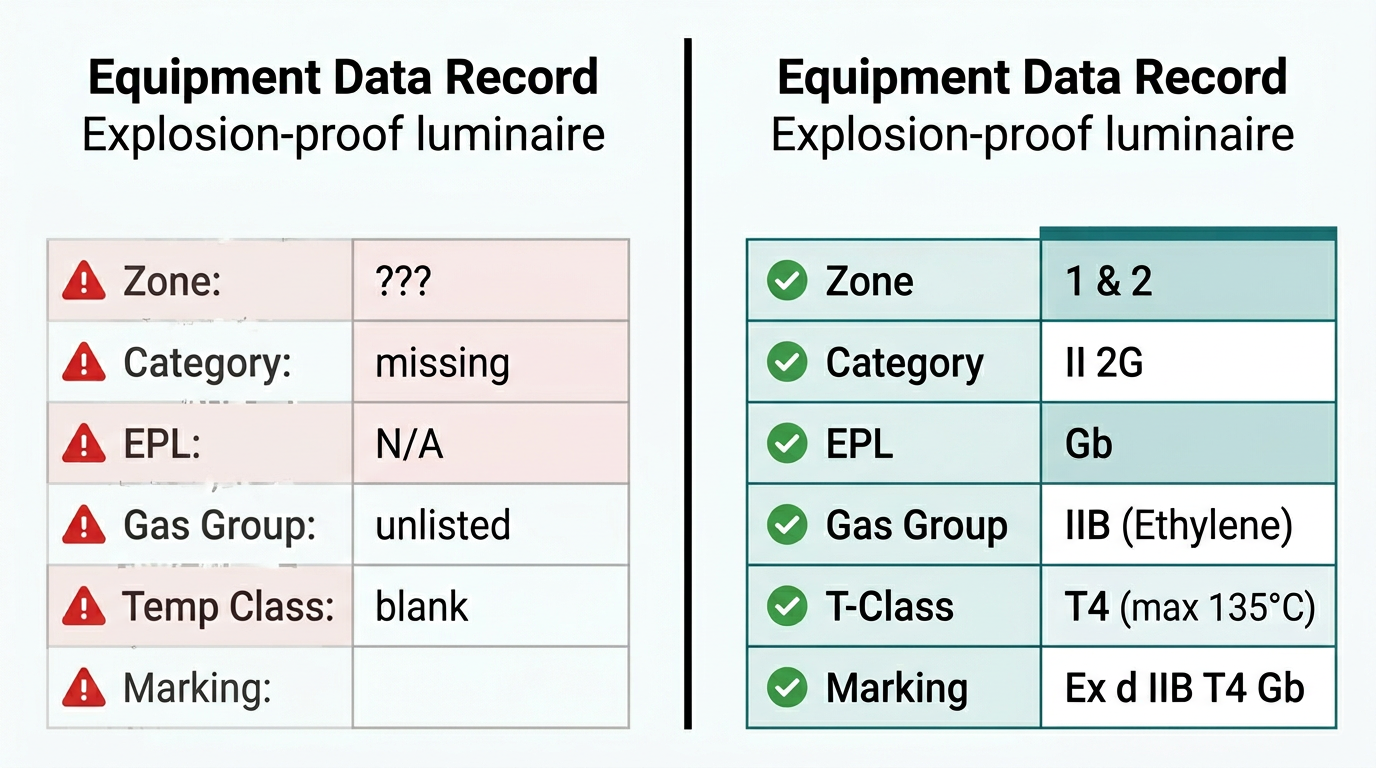
Marking string: Ex II 2G Ex d IIB T4 Gb
| Token | Meaning | What it tells you |
|---|---|---|
| Ex | Explosion protection | This equipment is certified for hazardous areas |
| II | Equipment group | Surface industry (not mining, which is Group I) |
| 2G | Category 2, gas | Suitable for Zone 1 and Zone 2 |
| Ex d | Protection type | Flameproof enclosure |
| IIB | Gas group | Covers ethylene-class gases, not hydrogen |
| T4 | Temperature class | Max surface temp 135°C |
| Gb | EPL | Confirms Zone 1 and 2 permitted |
This motor can go in Zone 1 or Zone 2. It cannot go in Zone 0. It handles propane and ethylene but not hydrogen or acetylene (those need IIC). The 135°C surface limit must be below the auto-ignition temperature of whatever gas is present.
The substitution rule
Simple version: you can always over-spec, never under-spec.
Cat 1G equipment works in Zone 0, Zone 1, and Zone 2. It costs more. It's harder to source. But it's always compliant.
Cat 3G equipment works in Zone 2 only. Put it in Zone 1 and you've got a compliance violation. The marking says Gc. Zone 1 needs Gb or better.
Wrong: Cat 3G motor in Zone 1
- Marking shows "3G" and "Gc"
- EPL Gc is Zone 2 only
- Non-compliant installation
Correct: Cat 2G motor in Zone 1
- Marking shows "2G" and "Gb"
- EPL Gb covers Zone 1 and Zone 2
- Compliant installation
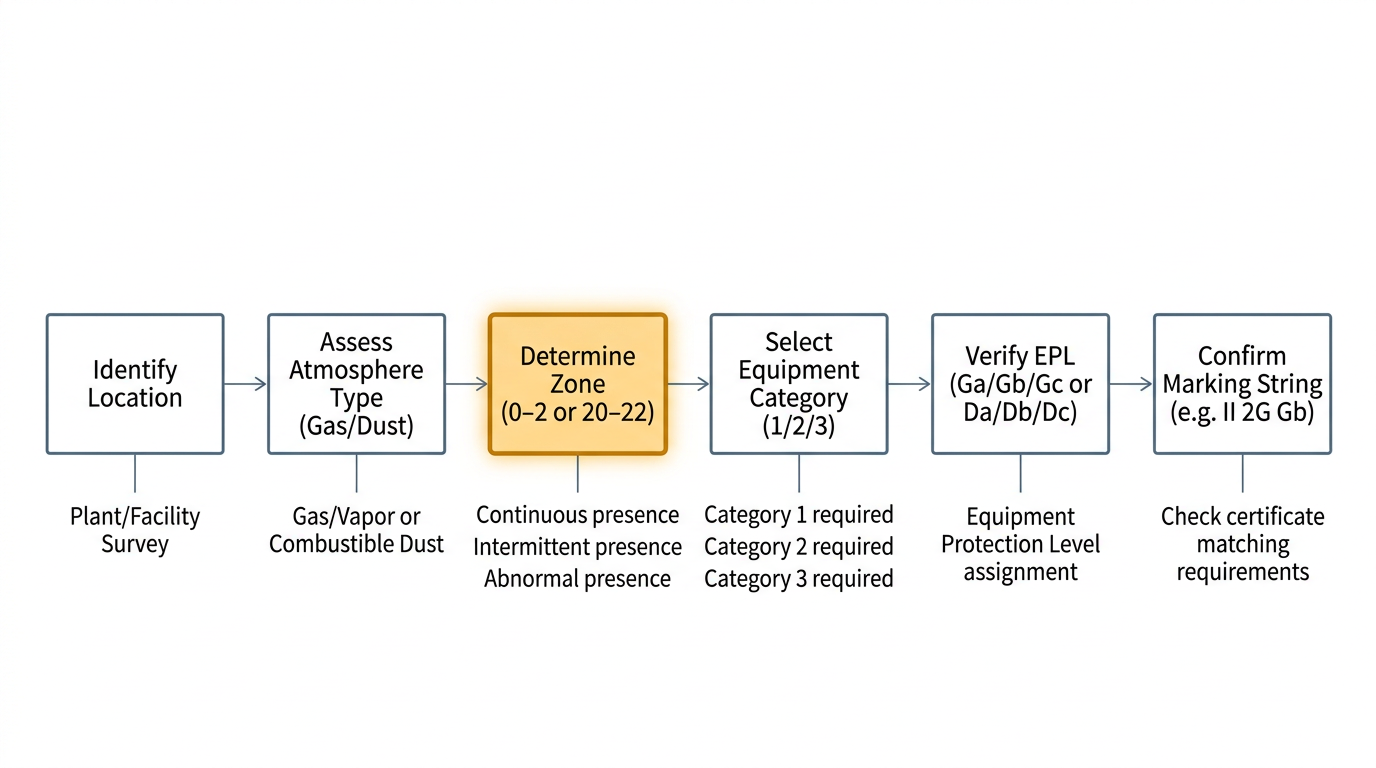
The most common mistake: someone reads "Zone 2" on a datasheet and installs the equipment in what they think is Zone 2. But the area classification drawing shows Zone 1 extending further than expected. Always check the zone drawing first.
Gas or dust atmosphere? Gas uses categories 1G/2G/3G. Dust uses 1D/2D/3D. Some locations have both.
What's the zone number? Zone 0 or 20 needs Category 1. Zone 1 or 21 needs Category 2 minimum. Zone 2 or 22 accepts Category 3.
Can I use higher-category equipment? Always. Cat 1G in Zone 2 is fine. More expensive, but compliant.
Can I use lower-category equipment? Never. Cat 3G in Zone 1 is a violation. No exceptions.
Zone hasn't been formally classified? Stop. Get an area classification study done per IEC 60079-10-1 or 10-2 before selecting equipment.
Gas groups and temperature classes
The zone tells you frequency. The gas group tells you reactivity. The T-class tells you ignition temperature.
Gas groups: IIA covers propane and butane. IIB covers ethylene. IIC covers hydrogen and acetylene. IIC certification covers everything below it.
Dust groups: IIIA is combustible fibres like cotton. IIIB is non-conductive dust like flour and grain. IIIC is conductive dust like metal powder. IIIC covers everything below it.
| T-class | Max surface temp | Typical application |
|---|---|---|
| T1 | 450°C | Hydrogen, methane |
| T2 | 300°C | Acetylene |
| T3 | 200°C | Petrol vapour |
| T4 | 135°C | Acetaldehyde |
| T5 | 100°C | — |
| T6 | 85°C | Carbon disulphide |
Match the T-class to the auto-ignition temperature of what's actually present. A T4-rated motor in an area with carbon disulphide (auto-ignition 90°C) is a problem. The 135°C surface can ignite it. If your equipment needs to serve markets outside Europe, compare the two certification schemes in our ATEX vs IECEx guide.