

Your ERP stores what you need to run transactions. Your website needs what you need to win searches and close carts. Nobody built the bridge. This article shows exactly what's missing and three ways to bridge the gap without replacing your ERP or buying enterprise PIM.
What your ERP export actually contains
Open an ERP export CSV. This is a real row from Eclipse for a Schneider Electric contactor:
| SKU | Description | Category | Price | Stock | Supplier | UOM | Weight |
|---|---|---|---|---|---|---|---|
| SQD-LC1D25G7 | CONT 25A 120V 3P | 441 | $127.40 | 23 | SQRD | EA | 0.85 |
That's it. Eight columns. The description is 18 characters because Eclipse limits that field to 40. The category is an internal code your buyers understand. There's no image URL, no technical specifications, no marketing copy, no classification code.
Prophet 21 and Distribution One follow the same pattern. They store operational data: what's in stock, what it costs, how to invoice it. A warehouse picker scanning SQD-LC1D25G7 needs "CONT 25A 120V 3P" and a bin location. An inside sales rep reading from a screen needs price and availability. That's what the ERP was built to deliver.
What your ecommerce platform needs for the same product
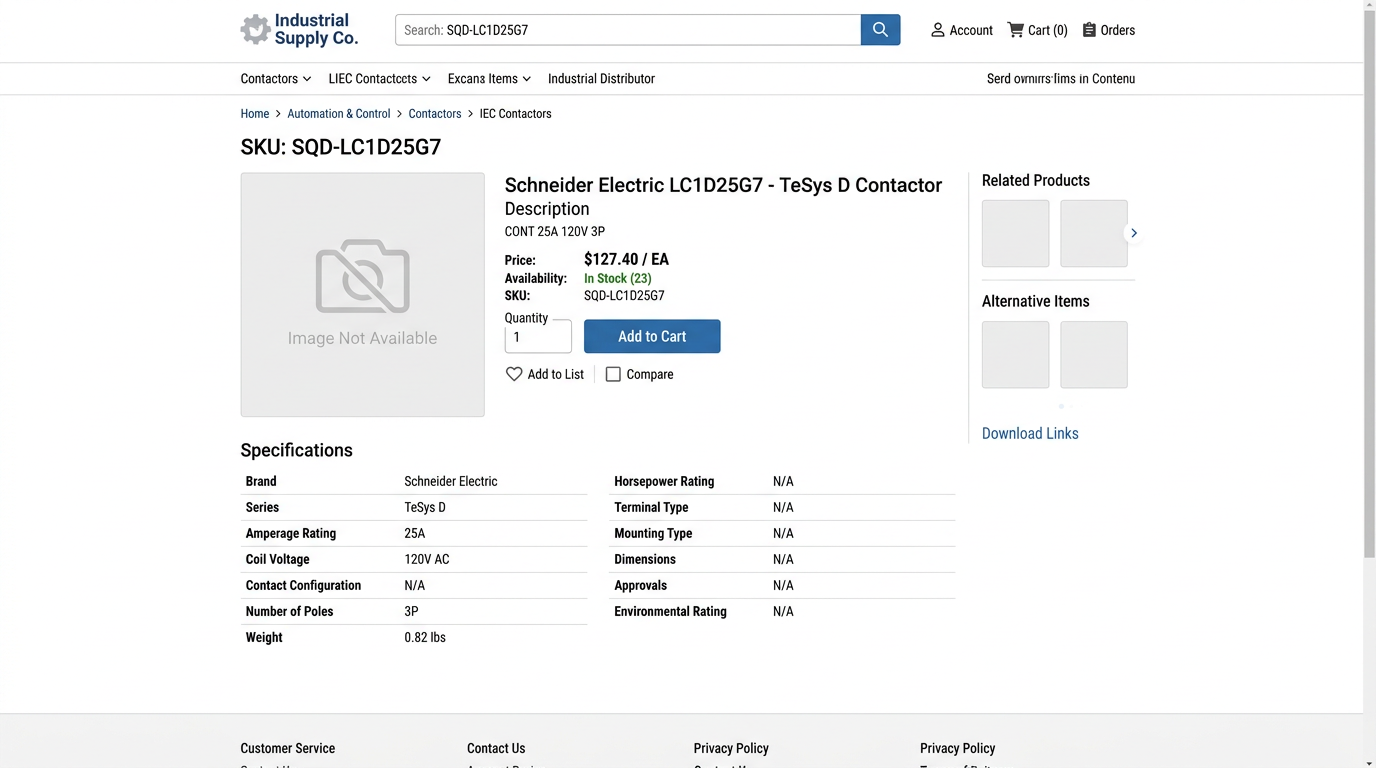
The same contactor on a working product page needs 28+ populated fields. Export your product data and compare what you're sending versus what displays on the page. The majority of your SKUs show incomplete listings: truncated descriptions, missing specs, no images, broken filters.
The full set your ecommerce platform expects:
Full product name: Schneider Electric TeSys D Contactor, 3-Pole, 25A, 120V AC Coil
Marketing description: 150+ words explaining applications, competitive advantages, and use cases
12+ technical specifications with proper units and formatting: coil voltage (120 V AC), pole count (3-pole), contact rating (25A at 440V AC-3), mounting type, terminal type, operating temperature range, certifications, ETIM class (EC001584), UNSPSC code (39121410)
Media assets: 3+ product images, PDF datasheet link, dimensional drawing
Relational data: Cross-sells, related accessories, replacement parts
Compliance marks: UL logo, CE mark, RoHS badge
The gap between 8 fields and 28 fields is why your website shows 40,000 descriptions when your ERP has 150,000 SKUs.
Why the gap exists
Your ERP doesn't have a field for ETIM class because it didn't exist when the database schema was written. Your ecommerce platform doesn't care about your internal category code 441. ERPs were built for internal operations: inventory tracking, order entry, invoicing. A 40-character description is enough for those workflows.
Your ecommerce platform inherited assumptions from B2C retail: rich content, SEO optimization, filterable specs. It expects data structured for search engines and conversion funnels.
The problem isn't your ERP or your ecommerce platform. Both are doing exactly what they were designed to do. Nobody built the bridge.
The three bridges
| Approach | Cost | Maintenance | Data freshness | Coverage | Best for |
|---|---|---|---|---|---|
| Direct enrichment layer | $2k-15k/year for data subscriptions | Medium - monthly mapping updates | 24-48 hour lag | 70-85% of SKUs | Distributors with fewer than 50k SKUs, stable catalog, single storefront |
| Lightweight PIM | $25k-80k/year license + setup | Low - managed in PIM UI | Real-time or hourly sync | 95%+ with manual fallback | Multiple storefronts, frequent catalog changes, in-house marketing team |
| Spreadsheet + scripts | $0-500/year for scripts | High - every SKU touched manually | Weekly or slower | 40-60% depending on capacity | Fewer than 10k SKUs, tight budgets, piloting one category |
The direct enrichment layer works by exporting ERP data nightly, running it through a script or service that appends manufacturer data from ICES, IDW, or direct feeds, mapping to ETIM/UNSPSC, and injecting the results into your ecommerce platform. Your ERP stays as the source of truth for price and stock.
A lightweight PIM sits between ERP and ecommerce as middleware. Your ERP remains the system of record for price and stock. The PIM stores enriched content and syncs both directions. You manage descriptions, specs, and images in the PIM interface.
Spreadsheet enrichment is the simplest path. Export ERP data weekly. Manually enrich in Google Sheets (add descriptions, specs, image URLs). Run an import script to push enriched data to your ecommerce platform. Slow but cheap for small catalogs.
What good looks like
ERP export row
- SKU: SQD-LC1D25G7
- Description: CONT 25A 120V 3P
- Category: 441
- Price: $127.40
- Stock: 23
- 4 other empty fields
Enriched ecommerce record
- Full product name with manufacturer
- 180-word marketing description
- 12 technical specifications with units
- 3 product images + datasheet PDF
- ETIM EC001584, UNSPSC 39121410
- 8 related accessories
- UL, CE, RoHS certifications
- Exported one product category from ERP as CSV
- Counted how many fields are actually populated
- Checked what your ecommerce platform displays for those SKUs
- Identified which manufacturer data feeds you have access to
- Estimated how many SKUs need enrichment (not just new ones)
- Talked to 2-3 distributors who solved this problem
When to move from bridge to PIM
Managing 3+ storefronts or multiple brands: PIM. Catalog changes weekly and you have a content team: PIM. ERP export works for 90% of SKUs, gap is just images: Stay with enrichment layer. Spending more than 20 hours/week on manual data entry: Time for PIM or automated enrichment.