
Most electrical distributor records have 15-20 populated fields. A complete ecommerce-ready record needs 58. The gap is not about data quality. It is about which fields you are tracking at all. A contractor ordering the wrong coil voltage is not a training problem. It is a missing field.
The gap between 17 fields and 58 fields
Open your PIM and pull up a Schneider Electric LC1D25G7 contactor. Most distributors carry this part. Now count how many fields are actually populated.
Typical distributor record (17 fields)
- Part number: LC1D25G7
- Description: CONTACTOR 25A 120V
- Manufacturer: Schneider Electric
- Price: $87.42
- Stock status: In stock
- Category: Contactors
- PDF datasheet link
- Image: generic contactor photo
- UPC code, Country of origin
- ...plus 7 more basic fields
Complete ecommerce-ready record (58 fields) All the fields at left, plus:
- ETIM class EC000205
- Coil voltage: 120 V AC 50/60 Hz
- Rated current: 25A at AC-3
- Number of poles: 3NO
- Auxiliary contacts: 1NO+1NC
- Terminal type: Screw clamp, 14-10 AWG
- Mounting: DIN rail, 35mm
- NEMA size: Size 1
- Compatible overload relays: LRD07-LRD32
- Compatible aux blocks: LA1DN11, LA1DN02
- ...plus 30 more specification and compatibility fields
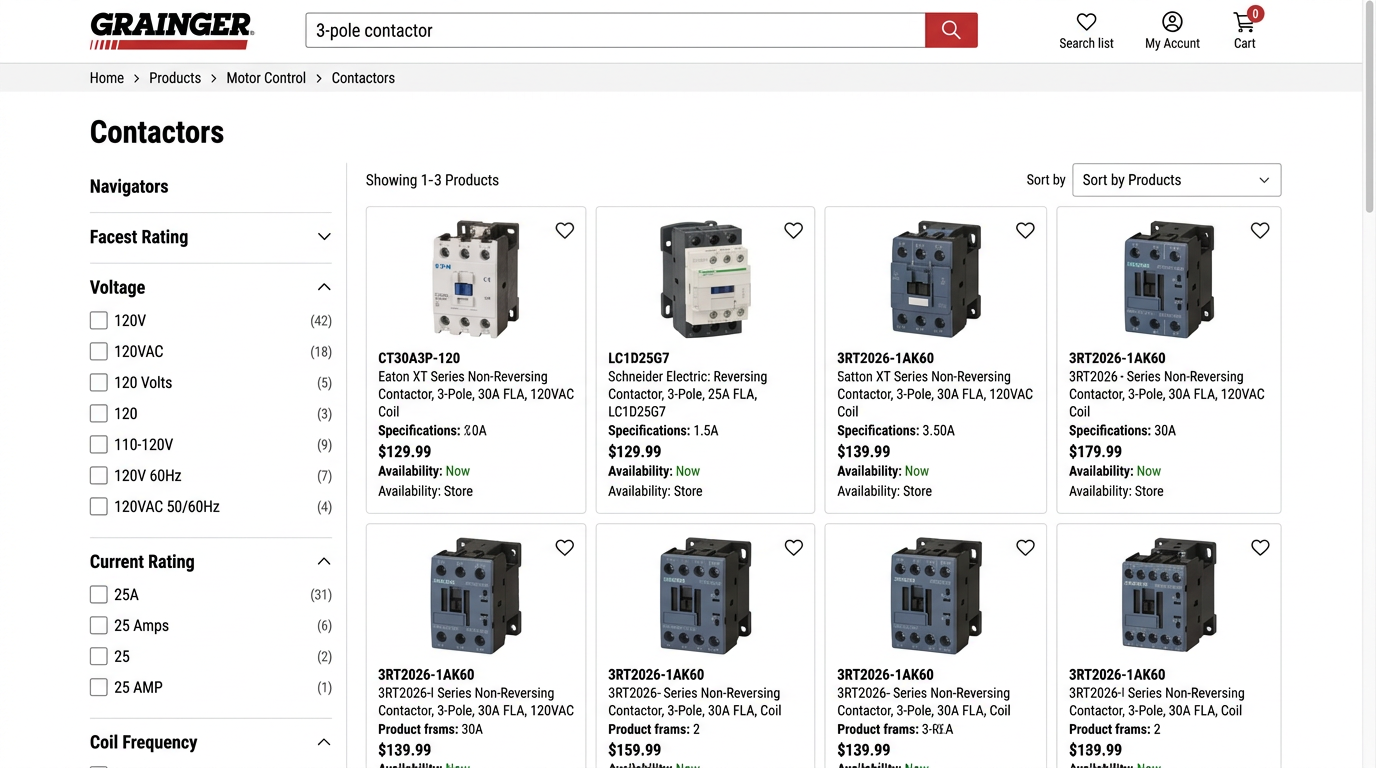
Your storefront filter showing 4 options for "120V" voltage exists because you're indexing unstructured text, not filterable attributes. Most distributors populate less than half the fields that drive search and cross-sell.
Fields that make products findable
Search relevance depends on structured attributes, not longer descriptions. When someone searches "25 amp 3 pole contactor 120v" your product needs to match on each token independently.
| Field | Example value | Enables |
|---|---|---|
| Product name | TeSys D contactor | Keyword search on series |
| ETIM class | EC000205 | Parametric search across manufacturers |
| Coil voltage | 120 V AC 50/60 Hz | Filter by voltage without text parsing |
| Application keywords | motor control, pump | Expand search without exact match |
The ETIM standard provides uniform product classification for technical products. When voltage is a searchable attribute field instead of buried text, buyers can filter before they even read a description.
Fields that make filters work
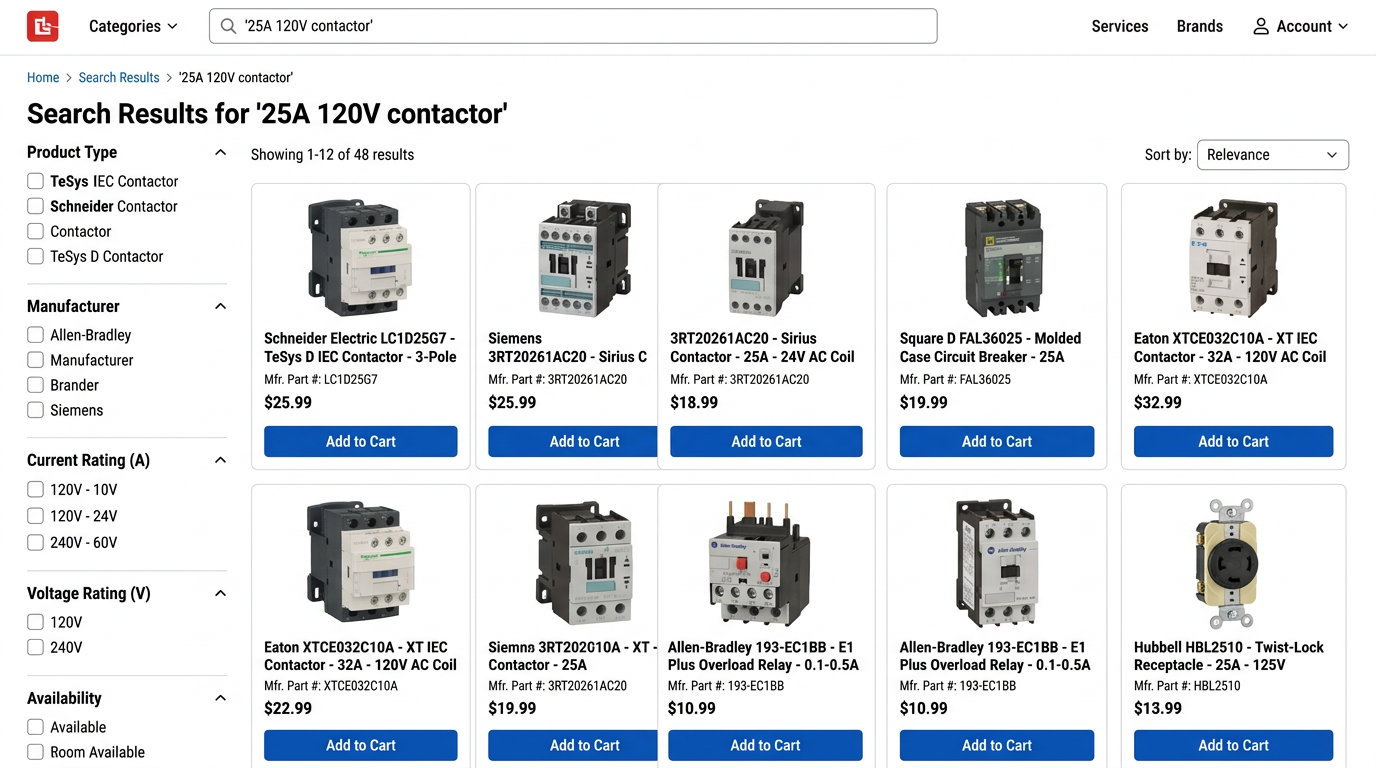
Your storefront filters fail when the same product attribute appears 5 different ways. Export the raw values behind your voltage filter right now. You'll see 240V, 240VAC, 240 VAC, 240V AC, and 240 V AC 50/60Hz all rendering as separate options.
Spacing or abbreviation only: Normalize to canonical format (240 V AC) and merge.
Different frequency specification: Keep separate if buyers filter by frequency (50Hz vs 60Hz). Merge otherwise.
AC vs DC distinction: Always keep separate. Ordering a 120VAC coil when you need 24VDC is a return.
Different mounting or terminal types: Keep separate. These determine physical compatibility.
Normalization happens before indexing, not in the storefront UI. The fields that control filter accuracy are coil voltage, rated current, number of poles, auxiliary contact configuration, mounting type, terminal type, and NEMA size equivalent.
Fields that prevent returns and wrong orders
A contractor in Denver opened a box with an LC1D25G7 on a job site. The contactor was correct, 25A, 3-pole, screw terminals. But the site control system runs 24VDC, and this unit has a 120VAC coil. The distributor listing said "CONTACTOR 25A" with voltage buried in page 3 of a PDF datasheet.
Fields that would have prevented the return
| Field | Value | Why it matters |
|---|---|---|
| Coil voltage | 120 V AC 50/60 Hz | Distinct from load voltage, shown as filterable spec |
| Auxiliary contacts | 1NO+1NC | Must match control circuit requirements |
| Terminal type | Screw clamp, 14-10 AWG | Determines wire compatibility on site |
The PDF had all this data. But PDFs don't populate filters, comparison charts, or mobile product cards. Structured specification fields do.
The specification fields that reduce returns are coil voltage with frequency, rated operational current with duty cycle, auxiliary contact configuration, terminal type with wire gauge, physical dimensions, operating temperature range, IP rating, UL and CSA certification numbers, and country of origin.
Fields that enable cross-sell and upsell
Compatible accessories require relational data linking products to what works with them.
| Field | Example | Cross-sell opportunity |
|---|---|---|
| Compatible overload relay | LRD07-LRD32 | Suggest matching relay at cart |
| Compatible aux blocks | LA1DN11, LA1DN02 | Bundle contact blocks |
| Wire gauge | 14-10 AWG | Cross-sell wire and terminals |
Grainger's Frequently Bought Together works because they track compatibility fields in structured form. When the LC1D25G7 goes in the cart, suggesting an LRD21 relay requires knowing the contactor's current rating and which relay series is compatible. Baymard research identifies compatibility as one of four essential attributes for effective cross-sell.
Fields that keep the catalog current
Your buyers can't filter by lead time if it's not a field. Lifecycle status prevents quoting parts that went obsolete two months ago.
Lifecycle and operational fields update more frequently than specifications. Product lifecycle status (active, obsolete, limited availability), lead time in days, minimum order quantity, superseded-by part numbers, and last specification update date are the fields that keep catalog operations running smoothly.
Fields rarely populated but high-value
These fields exist in manufacturer datasheets but almost never make it into distributor PIMs.
- Electrical durability (mechanical life, electrical life at rated duty)
- Short circuit current rating (SCCR in kA)
- Ambient temperature derating curve data
- Coil replacement part number (separate from main assembly)
- Physical mounting hole spacing as dimensions
Most PIM schemas don't even support these field types. Adding them requires schema changes, not just data entry.
How to prioritize the buildout
Start with fields that fix broken filters and enable cross-sell, not marketing content or lifestyle images.
Pull raw indexed values for coil voltage, current rating, poles, and mounting type. Count distinct values per attribute. Anything above 8-10 options for the same logical value needs normalization rules before re-indexing.
Compatible accessories, recommended wire gauge, mounting rail spec. Measure attach rate on suggested products. Track which compatibility fields drive the most cart additions.
Exact voltage with frequency, terminal type with wire gauge range, auxiliary contact configuration, dimensions. Track return reason codes for "wrong product" before and after.
These improve operations but don't move core metrics like conversion rate, average order value, or return rate. Save them for the cleanup phase.